Description
The Modena system is based on the water distribution system in Modena, Italy and was originally developed by Bragalli et al. in 2008 as part of a design optimization study. The system has a total demand of 53,000 CMD, four reservoirs, and 72 km of pipe. It is classified as distribution dense-grid by Hwang & Lansey (2017) and looped by Hoagland et al. (2015).
It was published 2021 by University of Kentucky Libraries.
The network consists of 268 nodes (junctions), 317 pipes and 4 reservoirs.
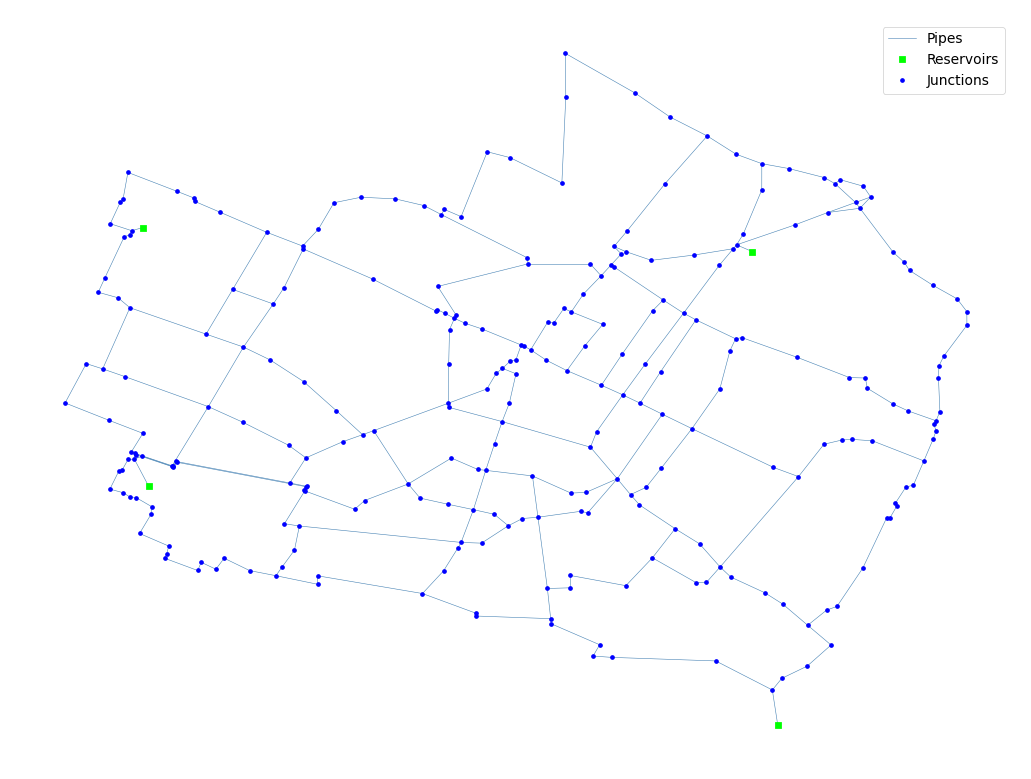
How to Use
The Modena network is provided as an .inp file and can be loaded into EPANET or any other software package supporting .inp files.
Usage in Python
The Modena network is also available in Python through the key “Network-Modena”:
network = load("Network-Modena")
modena_inp = network.load()
Detailed information about the provided functionality can be found in the documentation of
load().
Design Problem Description
Modena Network (MOD) includes three hundred and seventeen pipes, two hundred and sixty-eight demand nodes, and four reservoirs with fixed head within 72.0 m to 74.5 m. The pipe material is the same as PES. A uniform Hazen-Williams roughness coefficient of 130 is applied to all pipes. The minimum pressure head of all the demand nodes is maintained at 20 m. The maximum pressure head of each node of MOD is provided in Table MOD1 In addition, the flow velocity in each pipe is enforced to be less than or equal to 2 m/s.
Costs in the Network Design Problem
Diameter options and associdated costs:
Maximum Pressure Design Problem
Max Pressure:
Reference
Hall, Ashley, “05 Modena” (2021). International Systems. 5.
Bragalli, C. Ambrosio, D., Lee, J., Lodi, A., Toth, P. 2008. IBM Research Report: Water Network Design by MINLP. RC24495 (W0802-056)
Creaco, E. and Franchini, M. (2014) Low level hybrid procedure for the multi-objective design of water distribution networks, Procedia Engineering 70, 369 – 378
Bi, W., Dandy, G. C. and Maier, H. R. (2015) Improved genetic algorithm optimization of water distribution system design by incorporating domain knowledge, Environmental Modelling & Software, Vol. 69, 370-381.