Description
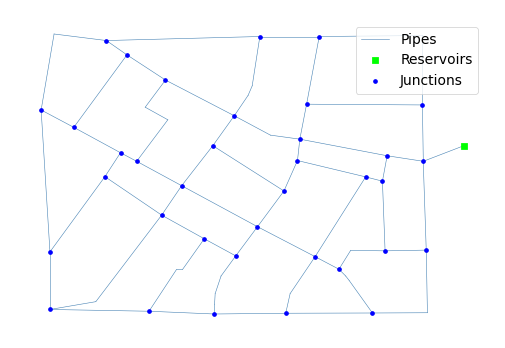
The Fossolo system is based on the Fossolo neighborhood distribution system in Bologna, Italy and was originally developed by Bragalli et al. in 2008 as part of a design optimization study. The system has a total demand of 3,000 CMD, one reservoir, and 8.4 km of pipe. It is classified as transmission dense-loop by Hwang & Lansey (2017) and looped by Hoagland et al. (2015).
It was published 2016 by University of Kentucky Libraries.
The network consists of 36 nodes (junctions), 58 pipes and 1 reservoir.
How to Use
The Fossolo network is provided as an .inp file and can be loaded into EPANET or any other software package supporting .inp files.
Usage in Python
The Fossolo network is also available in Python through the key “Network-Fossolo”:
network = load("Network-Fossolo")
fossolo_inp = network.load()
Detailed information about the provided functionality can be found in the documentation of
load().
Design Problem Description
Fossolo Network (FOS) includes fifty-eight pipes, thirty-six demand nodes, and one reservoir with a fixed head of 121.00 m. The material for all the pipes is polyethylene. Due to the feature of polyethylene, a relatively high roughness coefficient of 150 is applied to all the pipes. The minimum pressure head of all the demand nodes is maintained at 40 m, while the maximum pressure head of each node is specified in Table FOS.1. In addition, the flow velocity in each pipe is enforced to be less than or equal to 1 m/s. Table FOS.2 shows commercially available diameters and the corresponding unit costs.
Maximum Pressure Design Problem
Max Pressure:
Costs in the Network Design Problem
Diameter options and associdated costs:
Reference
Dandy, Graeme, “03 Fossolo” (2016). International Systems. 3.
Bragalli, C. Ambrosio, D., Lee, J., Lodi, A., Toth, P. 2008. IBM Research Report: Water Network Design by MINLP. RC24495 (W0802-056)
Creaco, E. and Franchini, M. (2014) Low level hybrid procedure for the multi-objective design of water distribution networks, Procedia Engineering 70, 369 – 378
Bi, W., Dandy, G. C. and Maier, H. R. (2015) Improved genetic algorithm optimization of water distribution system design by incorporating domain knowledge, Environmental Modelling & Software, Vol. 69, 370-381.